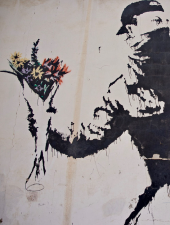
Artists, this special group, are renowned not only for their creativity but also for their warm and compassionate hearts. The expression of art and emotion is the essence of this profound field. It is this compassionate heart that empowers artists beyond mere technique, enabling them to convey love and care more profoundly. In their works, we often see calls for justice, equality, and friendship—a way for artists to engage in dialogue with the world through their hearts and emotions.
Due to historical reasons, racial issues are prominently reflected in contemporary American art. For various minority groups in the United States, their life experiences and political attitudes have long been influenced by their racial survival patterns. The Black community, compared to the dominant white population, has long been in a disadvantaged position, which explains why the entire nation of Black Americans was thrilled when Obama became the first Black president of the United States. Racial discrimination has deep-seated psychological, economic, and social causes, and Black culture, as an important part of American culture, still carries a strong sense of prejudice. Therefore, the response of Black art to this opposition typically manifests as a vigorous effort to prove the cultural value of their race that was not previously recognized by the "center," and on this basis, the establishment of a targeted critical discourse and theoretical system to effectively interpret art with racial characteristics. This is particularly prominent in African American culture.
Titus Kaphar's work, *Space to Forget*
In late May 2020, George Floyd, an African American man in Minneapolis, Minnesota, was arrested for allegedly using counterfeit money. A white police officer knelt on his neck for 8 minutes and 46 seconds, ignoring Floyd's repeated pleas for help, leading to his death by asphyxiation. A witness livestreamed the incident on his cell phone, igniting social media outrage. Subsequently, peaceful demonstrations across the United States demanding government attention to racial discrimination escalated into large-scale riots, even spreading beyond the United States. On June 4th, Time magazine released its new cover featuring Titus Kaphar's "Analogous Colors," a work depicting an African American mother holding her child, but the child's portion has been cut off, leaving only blank space, directly referencing the death of George Floyd. The Black community, suffering from racial discrimination, has once again become a focal point.
Titus Kaphar's "Analogous Colors"
"I can't breathe," Floyd's last words, represented the minimum plea of the vulnerable to the powerful, becoming a rallying cry for protesters. More than half a month later, the situation has not subsided. This is the largest wave of protests in the United States since the Civil Rights Movement of the 1960s. Massive unemployment due to the pandemic, a severely impacted economy, and changing international circumstances have further destabilized the already turbulent situation in the United States. The killing of an African American man by a white police officer became the final straw.
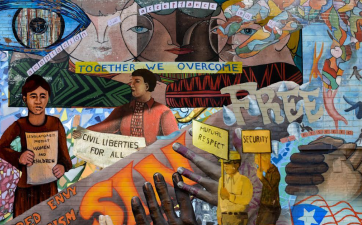
British graffiti artist Banksy's artwork posted on social media in support of the Black Lives Matter movement
fighting against racial discrimination and for democratic equality. Following the George Floyd incident, the official Instagram account of "Black Lives Matter" quickly gained 2.9 million followers. "Black Lives Matter" is a Black human rights organization founded in 2013. Many artists and charities have collaborated with the organization on social media to create art or reflect on the development of past Black Lives Matter movements. Since June, artists Banksy, Titus Kaphar, Adam Pendleton, and art institutions such as Pace Gallery and the Museum of Modern Art (MoMA) have all posted related content and works on social media, highlighting the immense empathetic role of visual art in advocacy.
With each rise of a Black Lives Matter movement, regardless of its level, tangible changes are always visible. Art, in turn, speaks out for Black rights in a way and through means, constituting a phenomenon within artistic modernity, thus writing and recording history. Years later, stepping back from today's chaotic situation and looking back at the art that champions Black people today, we may better appreciate its role in driving history forward.